
When people look at Hungary’s tourism data, they tend to focus on demand without looking at the cause of the demand. If you look outside the capital, Budapest, its less about pleasure and more about industry.
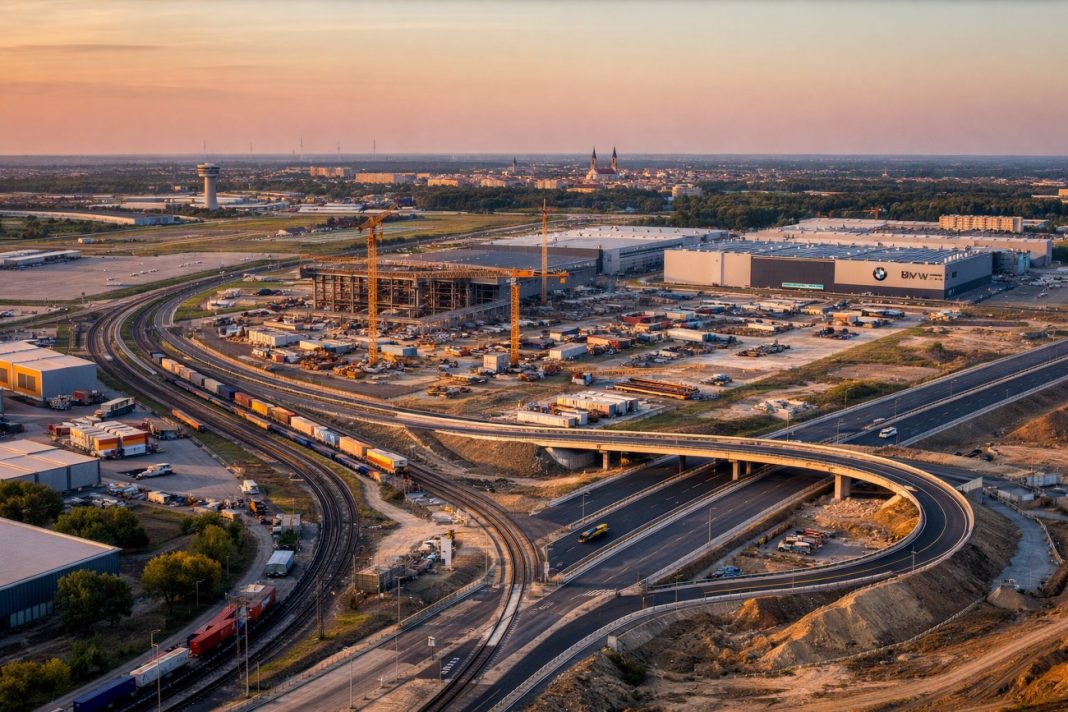
If you really want to understand what’s happening, you need to look at infrastructure — and nowhere is that clearer than Debrecen International Airport. Because what’s being built around Debrecen isn’t just an airport upgrade. It’s a coordinated expansion of an entire economic ecosystem.
There are ongoing plans to expand Debrecen Airport’s passenger capacity from roughly 600–700 thousand annually toward 1.5–2 million over time. On paper, that looks like a tourism-led move. In reality, it’s the opposite. Passenger growth is not the driver — it’s the outcome of broader structural changes taking place across the region.
The real shift is happening on the cargo side. Debrecen has already seen freight volumes rise from negligible levels to thousands of tonnes annually, and that trajectory is expected to continue as industrial activity scales. This aligns directly with the rise of Debrecen as a manufacturing hub, anchored by the arrival of the BMW Group plant, but increasingly defined by a wider cluster of battery and energy-related investments.
Companies such as CATL, alongside other major players like EVE Energy and a growing network of suppliers, are turning Debrecen into one of Europe’s most concentrated EV and battery production zones. That concentration matters. It creates predictable cargo flows, consistent business travel and long-term economic gravity — the kind of conditions airlines actually respond to.
At the same time, Debrecen is positioning itself along the China–Europe rail freight corridor, part of the broader Belt and Road Initiative. This adds another layer entirely. Rail brings volume from Asia, road distributes regionally and air handles high-value, time-sensitive goods. Once that multimodal structure is in place, aviation becomes commercially viable in a very different way.
This is also why the tourism data needs to be read more carefully. Strong numbers from countries like Italy, the UK and Germany reflect route availability as much as demand. And the softer Asian figures tell a similar story in reverse. Earlier spikes were influenced by temporary project-phase travel linked to large-scale investments such as CATL, and as those projects move into operational phases, that travel naturally stabilises or subsides.
The same pattern is visible in the city’s hospitality sector. Over the past five years, Debrecen has seen a clear wave of hotel development, including international brands such as Hilton Garden Inn and Mercure establish hotels, alongside expansions across existing properties. Several hundred new rooms have entered the market, with more in the pipeline. But again, this wasn’t driven by tourism in the traditional sense. It was driven by corporate travel, long-stay project teams, supplier ecosystems and the expectation of sustained business activity.
This is where the logic becomes clear. Routes are not created because tourists suddenly decide to travel somewhere. They are created because the underlying economic conditions justify them. Business travel comes first. Cargo follows. Infrastructure expands. And only then does tourism begin to scale.
Looking ahead, Debrecen’s route development will likely follow that same progression. European connections will continue to deepen, particularly to Germany, Italy and the UK, supported by business related flows. Additional links to hubs such as Amsterdam or Paris may emerge if the economic case strengthens. Longer term, cargo-driven routes to markets like China or the Middle East become plausible, with passenger services following only if demand stabilises.
All of this points to a broader shift in how regional growth is being structured. Hungary is no longer relying solely on Budapest as a single aviation and economic centre. Instead, a more layered model is emerging, where Budapest remains the primary global gateway while Debrecen develops as a logistics and industrial node with targeted connectivity.
The sequence is consistent. Infrastructure expands, industry follows, logistics scale, hotels are built, routes become viable and tourism grows as a result. Debrecen is moving through that sequence as I write this.
Business development creates the demand — infrastructure enables it and allows it to scale.
It’s easy to frame Debrecen’s growth as a tourism story. But that misses the point. This is about building a fully integrated economic node where rail, road, air, industry and hospitality align. Tourism is not leading this transformation. It’s following it.